
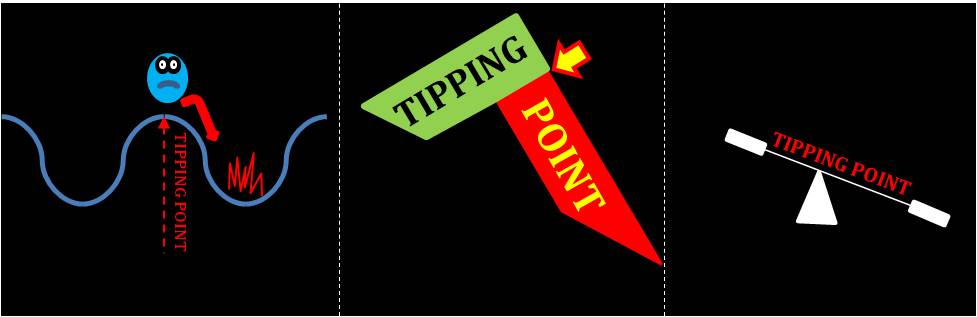
Since the elevation of the term tipping point by Malcolm Gladwell (2000), which he defines as “the moment of critical mass, the threshold, the boiling point,” globally and nationally, particularly here in the U.S., there appears to be many tipping points. If you consider a little history, tipping points come and go, and sometimes they linger. Can we learn from the past or is it true that our past does not guarantee an accurate future prediction? Is the late management pioneer and expert, Peter Drucker, correct in his perspective, “We are in one of those great historical periods that occur every 200 or 300 years when people don’t understand the world anymore, and the past is not sufficient to explain the future” (Cameron & Quinn, 2006, p. 1; citing Childress & Senn, 1995, p. 3). Could an open-minded resilient perspective change the way we view our environment within our borders and beyond? For example, several years ago, Sir Richard Branson, the Chairman of Virgin Group, contends, “The aviation industry is at a tipping point and will see many dynamics” that will shape the future industry including the following: (a) the survival of the fittest and the demise of the weakest; (b) how regulators protect consumers and smaller airlines from dominant groups or alliances; (c) whether Boeing can finally launch the game-changing 787 and prove its fuel-efficiency; (c) the success of a global aviation deal at the Copenhagen Summit; (d) and political decisions around Heathrow’s third runway. (Branson, 2009) Several of these dynamics most likely apply to other industries and certainly do apply to other nations, particularly the first two. As we look at tipping points again, how do we break through to the other side? How does a nation develop and sustain the resilient actions necessary to reestablish a strong economic and free-market environment? Does the key lie in free-market competition–survival of the fittest, less government involvement, and deregulation of private industry? Or does the key lie in a government attempting to regulate all aspects of its economy?
_____________________
References:
Branson, R. (June 8, 2009). Aviation’s Tipping Point (Guest Editor). Retrieved from http://www.flightglobal.com/blogs/2009/06/aviations-tipping-point—sir.html
Cameron, K. S, & Quinn, R. E. (2006). Diagnosing and changing organizational culture. California: Jossey-Bass.
Gladwell, M. (2000). The Tipping Point. New York: Little, Brown and Company.

 THE Resiliency Boot Camp